 The Vertex Journal
Tooling
Snowflake's semantic view cache is GA. Masked columns and physical SQL go around it.
Semantic view materializations reached general availability on November 11. What the pre-aggregation layer accelerates, and the queries its own documentation exempts.
By The editors · · 2 min
Snowflake moved semantic view materializations to general availability on November 11. The feature pre-aggregates the dimensions and metrics a semantic view serves most often, and the planner rewrites matching queries to read the stored result. A semantic layer with a cache, then. The release note sells query performance. The documentation lists who does not receive any.
The mechanics are a materialized view in all but name. ALTER SEMANTIC VIEW ... ADD MATERIALIZATION names a warehouse, background
refreshes run on it, and the view carries a MAX_STALENESS whose
floor is 120 seconds; a query is rewritten only while the stored
result is younger than that. Set the number lower than the refreshes
can sustain and "Snowflake automatically suspends the
materialization." Deploy with CREATE OR REPLACE SEMANTIC VIEW and it
"always drops all existing materializations immediately, regardless
of what changed."
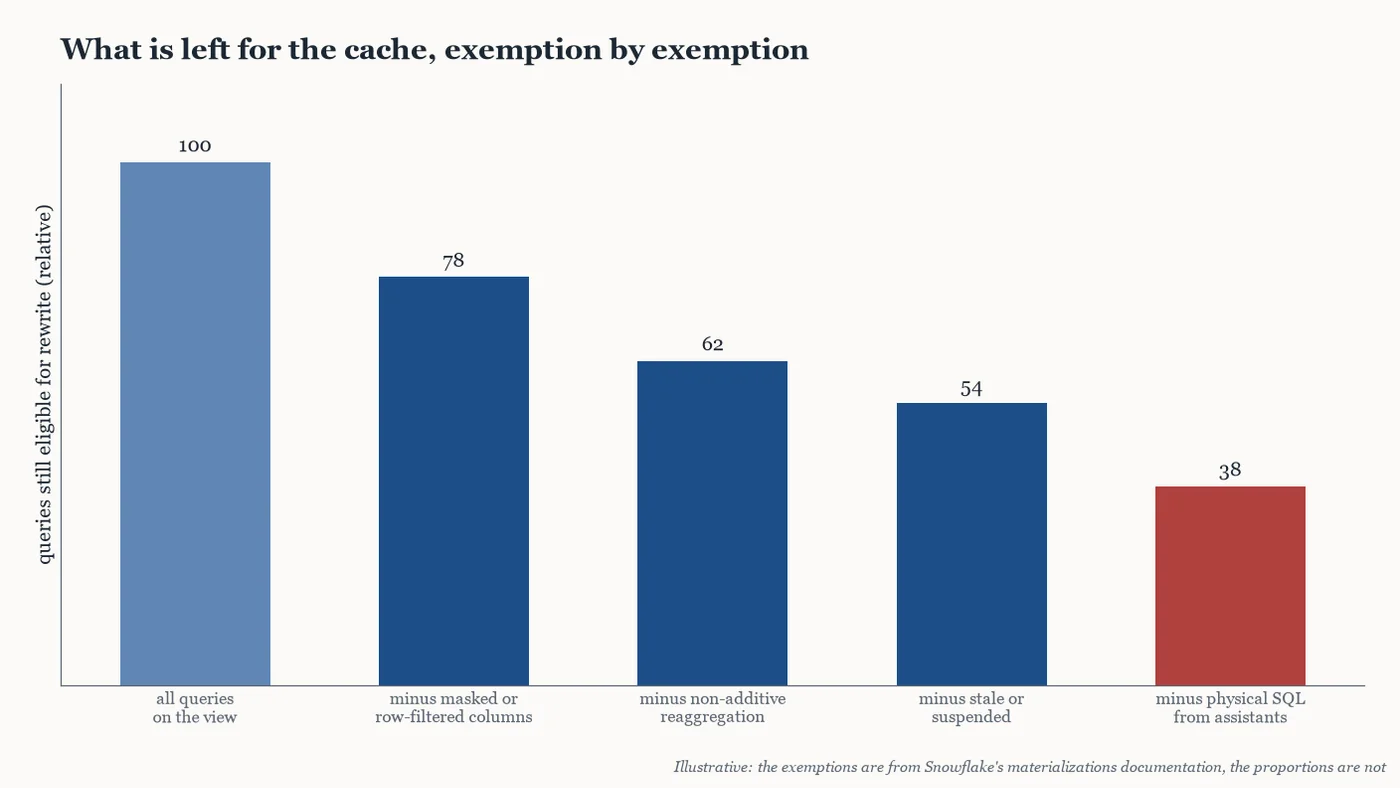
Now the exemptions. Under the heading "When materializations are not used" sits this line: "A masking policy or row access policy exists on a column that is referenced by the materialization." The columns a governance team took the trouble to protect are the ones the cache declines to serve. The same list includes "Non-additive metrics require reaggregation," so a distinct count is answered from storage only at the grain somebody thought to store.
Then the note that deserves a second reading. Materializations help queries written as semantic SQL. Queries from Cortex Analyst, Cortex Agents and Snowflake CoWork that run physical SQL against the underlying tables "do not benefit from semantic view materializations."
We wrote in 2024 that the failure mode of a semantic layer "is not an error but a silent fallback to direct SQL." Here the fallback is documented, and the callers named are the vendor's own assistants.
Our figure stacks the exemptions. The order is the documentation's and the proportions are ours, which is to say illustrative; your own split is one query-history report away.
Verdict: worth adopting, narrowly. Additive metrics on unmasked
columns, behind a dashboard that speaks semantic SQL, with a
staleness budget somebody signed. The GA release ships
SYSTEM$CHECK_SEMANTIC_VIEW_MATERIALIZATION_REWRITE, which tells you
whether a given query qualifies before you fund the refreshes. Run
it first. As the acceleration story for governed data or for the
assistants: wait.