 The Vertex Journal
Platforms
The table-format war became a catalog war
Iceberg's REST catalog spec ended the format fight by making it moot. The contest moved to the control plane, where Apache Polaris and Unity Catalog now sit.
By The editors · · 2 min
The verdict first, since this is a review and not a mystery. The argument about table formats is effectively over, and it ended not with a winner but with a shared interface. Apache Iceberg's REST catalog API, introduced back in the 0.14 release, turned the format question into a protocol question, and the protocol is the thing every engine now implements. The fight moved up a layer, to the catalog, which is where the lock-in and the money always intended to live.
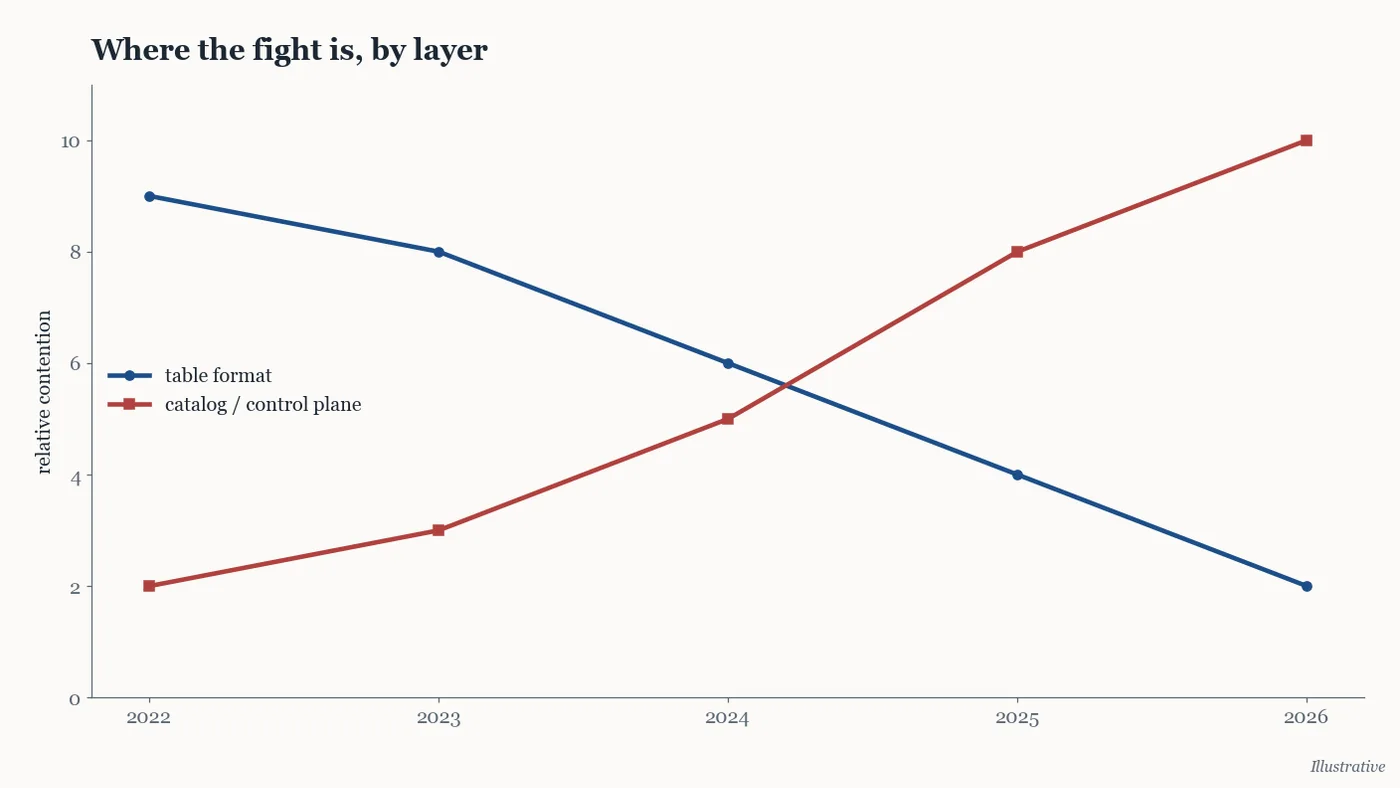
Apache Polaris is the clearest signal of where things landed. Snowflake built it, donated it to the Apache Software Foundation, and in February 2026 it graduated to a top-level project with a project committee drawn from Dremio, Google, Microsoft, Confluent, Bloomberg and Starburst as well as Snowflake, by Dremio's count. That is a strange roster to find around a Snowflake-born project, and it is exactly the point. Polaris implements the Iceberg REST spec and nothing else, so Spark, Trino, Flink, Doris and StarRocks all speak to it the same way. It is a control plane built on purpose to not be a moat.
Databricks open-sourced Unity Catalog under Apache 2.0 and took the opposite bet. Not Iceberg-only but multi-format: one catalog over Delta Lake, Iceberg through UniForm, plain Parquet and unstructured files. Read the two designs against each other and the strategies are legible. Polaris says the format is settled, so compete on the engine. Unity says the format is not settled, so catalog all of them and keep the customer inside the tent that handles all of them best. Both companies open-sourced the catalog. Neither open-sourced the reason you would pay them, which is the managed service, the governance layer and the support contract that sit on top.
What decides the contest is not code quality, because both are credible. It is which control plane the engines target by default, because a catalog with no engines is a database with no clients. For now the momentum sits with the Iceberg REST interface that both camps implement, and that is the useful fact for a buyer: the interoperable layer is real, and a catalog that speaks it is a catalog you can leave.
For a data team the practical read is calmer than the vendor noise around it. Pick the catalog that speaks the Iceberg REST API, because that is the bet with the most engines behind it and the cheapest exit, and treat the multi-format pitch as a genuine convenience with a genuine gravity well attached. The standoff we described as ending quietly ended exactly here: not with Iceberg beating Delta at the file level, but with the REST catalog making the file level the boring part. Adopt a catalog, not a format, and make Iceberg REST support the line in the evaluation you refuse to cross.