 The Vertex Journal
Platforms
The single-node renaissance is a correction, not a fad
DuckDB made one machine respectable again. A review of what the distributed decade got wrong about the size of actual data.
By The editors · · 4 min
The distributed decade ran on a flattering assumption: that everyone's data was about to be enormous. Most of it was not. Most analytical workloads fit comfortably in the memory of one modern machine, and the industry built clusters for them anyway, then spent years debugging shuffles for datasets a laptop could sort.
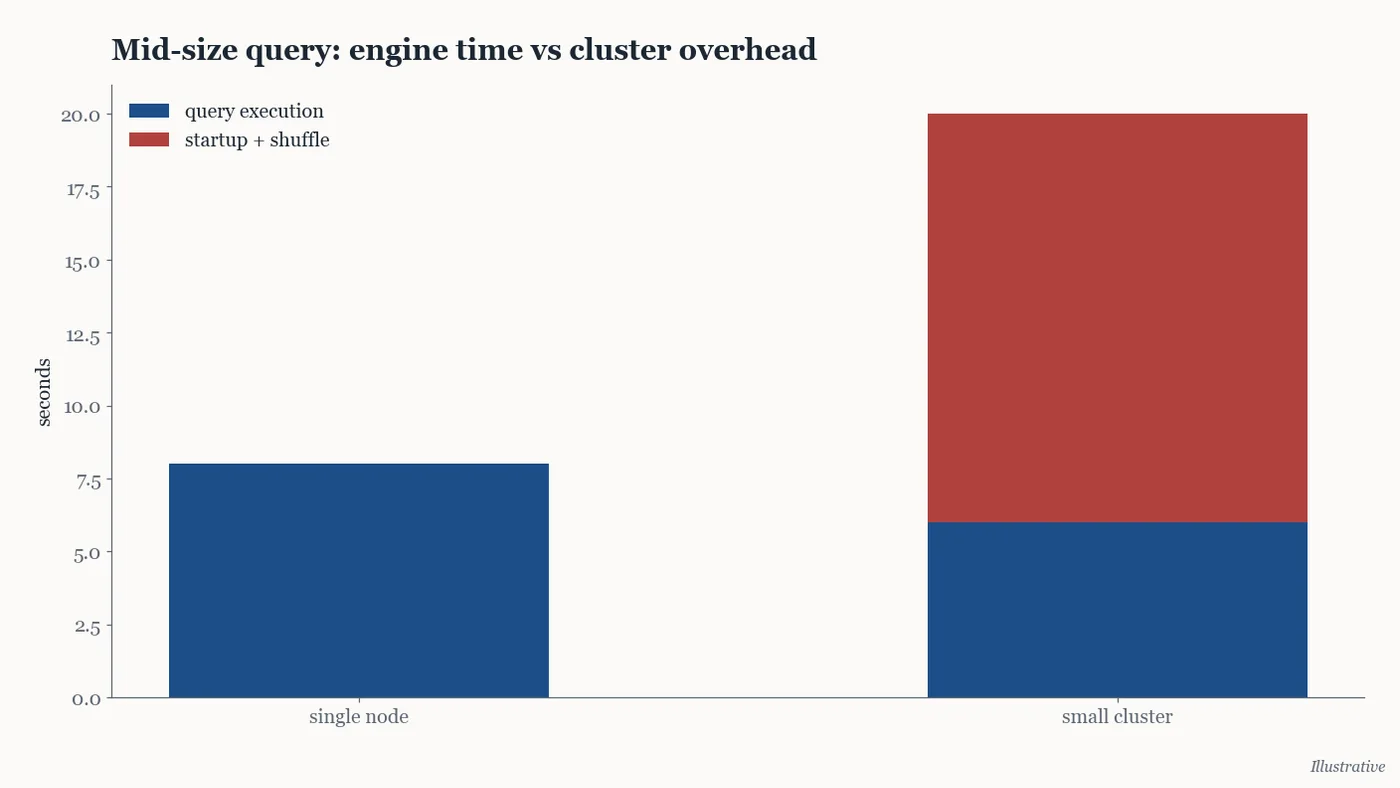
DuckDB is the correction. An in-process, vectorized analytical engine that reads Parquet where it lies and finishes mid-sized queries before a cluster would finish scheduling them. The embedded analytics write-ups cover the pattern well: for gigabytes to low terabytes, coordination overhead is the tax you pay for a problem you do not have.
what single-node changes in practice
Development loops shrink from minutes to seconds, which quietly improves every downstream decision because people iterate instead of batching their curiosity. Pipelines that were Spark jobs with one intermediate stage become a script. The CI environment can run the real engine, so tests test the thing that ships. None of this is exotic; it is what computing feels like when the network is not in the middle.
the honest boundary
The correction has edges. Petabyte scans, high-concurrency serving, and organization-wide governed access are still distributed problems, and the serverless variants exist precisely to scale the engine past one machine when that day arrives. The failure mode to avoid is symmetric: yesterday's error was a cluster for gigabytes; the new error would be a laptop for petabytes.
what it does to the bill
The warehouse bill is largely a coordination bill. You pay for compute that waits for other compute, for clusters sized to the worst hour of the month, and for the idle floor under all of it. Moving mid-sized workloads onto single nodes converts that spend into the cheapest line item in computing: one machine doing work it already fits. Teams running this split describe the same shape. The warehouse stays for the big joins and the governed serving layer, the exploratory and departmental work migrates down, and the bill stops growing even where usage does not. We would print harder numbers if vendors published comparable ones; they do not, and the incentive analysis for why is left as an exercise.
the architecture nobody draws
The diagram that actually emerges is a lake of Parquet with three kinds of readers: a warehouse for governed serving, single-node engines for everything mid-sized, and notebooks for the long tail. Nobody keynotes this architecture because it has no center, no product to sell, and no migration to bill for. It is also, not coincidentally, the cheapest arrangement we review and the one with the fewest moving parts on the incident timeline.
The prerequisite is file hygiene. Single-node engines reward well-partitioned, sanely sized Parquet the same way warehouses do, and they punish a landfill of tiny files worse, because no vendor optimizer stands between you and your own mess. Teams that skip the housekeeping blame the engine. The engine is fine.
The second prerequisite is a place for results to live. The pattern degrades when every analyst's laptop becomes a private warehouse with private numbers; the fix is boring and organizational, not technical. Shared queries land in version control, published tables land back in the lake with a name and an owner, and the laptop remains what it should be, a fast place to think rather than a slow place to publish. Teams that skip this step rediscover spreadsheet chaos with better compression.
the objections, reviewed
Concurrency is the serious one. An in-process engine embedded in a dashboard product serving hundreds of simultaneous readers is the wrong tool, and that serving layer should stay warehouse-shaped. Governance is the second: row-level policies and audit trails do not travel with a binary on a laptop, which is why regulated serving belongs upstream. The remaining objections are mostly identity. A generation of engineers was trained to believe serious data work is distributed, and conceding that the laptop wins can feel like a demotion. It is a promotion. The cluster was never the achievement; the answer was.
how to test the claim on your own estate
Take last month's query history and bucket it by bytes scanned. The shape of the distribution is public knowledge by now, most scans are small, but the exercise matters because it is your distribution, on your estate, and it converts an argument about fashion into an argument about a histogram. Then list the ten pipelines your team babysits hardest and ask which would fit in 128 gigabytes of memory. Usually most of them. The follow-up question, why they page a human when they could run under cron on a machine that costs less than the meeting discussing them, tends to end the debate. Run that review before the next contract renewal, which is when the histogram acquires negotiating power.
verdict
Worth adopting, aggressively, for the workloads that fit, which is more of your workloads than your architecture diagram admits. Size the platform to the data you have, not the data the vendor deck predicted you would have by now.