 The Vertex Journal
Platforms
Lakehouse or warehouse is a staffing question
The formats converged, the engines cross-read each other, and the real decision is about the team you have, not the architecture you admire.
By The editors · · 2 min
The lakehouse-versus-warehouse debate was framed as architecture and was always staffing. In 2026 the technical gap has narrowed to the point of embarrassment: warehouses read open table formats, Databricks fully supports Iceberg, and the comparison literature spends most of its pages on catalogs and governance rather than capability. What remains different is who does the work.
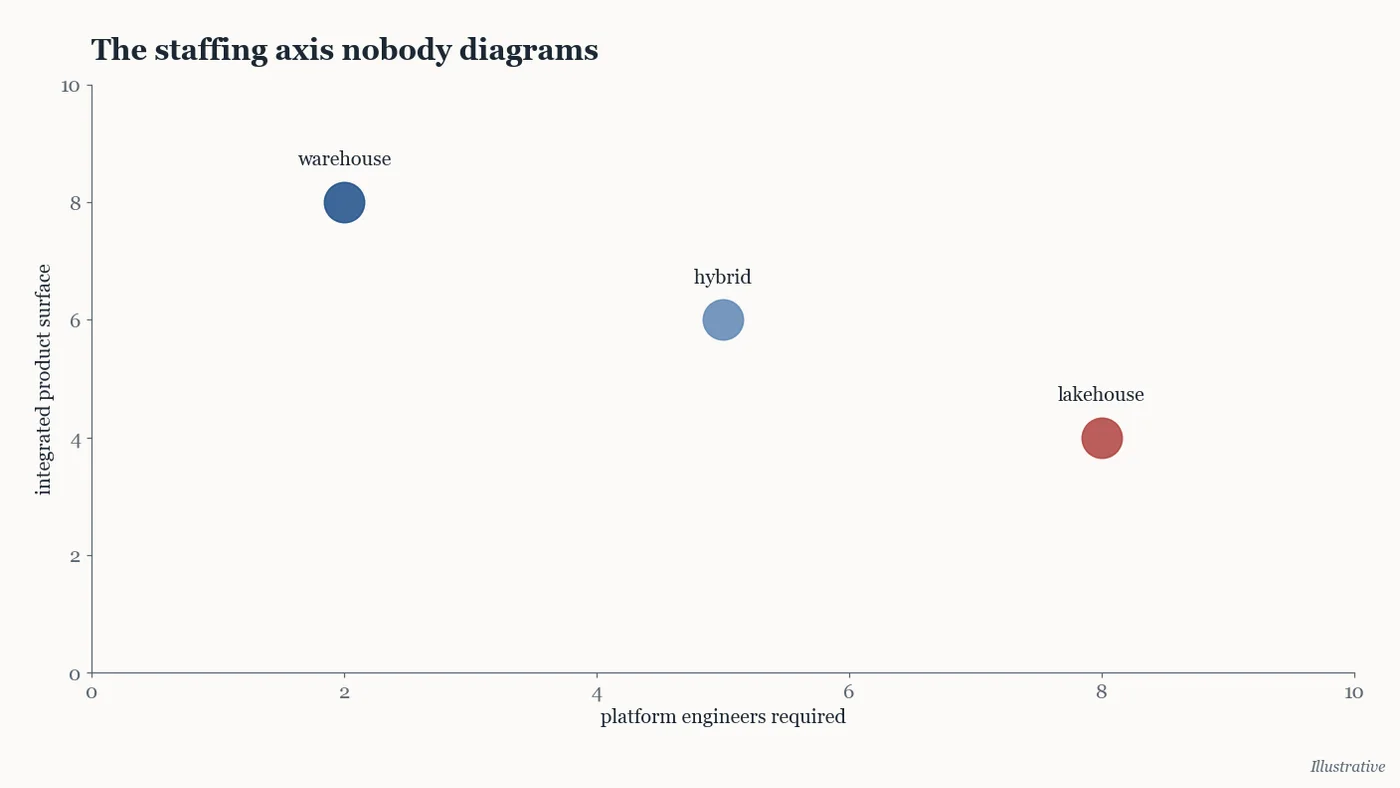
A warehouse is a product. Storage, compute, optimization and access control arrive integrated, and the price of integration is the meter running on someone else's margins. A lakehouse is a kit. Open storage, your choice of engines, real optionality for ML and streaming workloads, and the price of optionality is that table maintenance, compaction, catalog operations and security integration are now jobs on your team's calendar.
the honest decision table
Mostly SQL analytics, a lean data team, spend that fits the meter: the warehouse is not a compromise, it is the correct product, and the architecture blog posts calling it legacy are selling something. Diverse engines on the same data, ML pipelines beside BI, an actual platform team with on-call capacity: the lakehouse's optionality is real and compounding. A hybrid (warehouse for governed BI, open tables underneath for everything else) is no longer exotic; the format convergence made it the emerging default for larger shops.
the staffing math, made explicit
Since the argument is staffing, do the staffing arithmetic in the open. A lakehouse in production needs someone who owns compaction and table maintenance, someone who owns the catalog and its permission model, and someone who answers at 2 a.m. when a job corrupts a manifest; in small shops these are one exhausted person, which is the real meaning of "we run a lakehouse". Price that headcount honestly, including the hiring difficulty, and compare it to the warehouse premium on your actual query volume rather than on principle. Under roughly two full engineers of genuine platform capacity, the meter is almost always cheaper than the payroll. The reverse also holds: at the scale where the warehouse bill exceeds several platform salaries, the kit stops being a lifestyle choice and becomes a procurement one.
verdict
Count your platform engineers before you count your query engines. The kit is only cheaper than the product if assembly labor is free, and it has never once been free.