 The Vertex Journal
Economics
Lakehouse//RT got its own SKU before it got a GA date
Databricks' sub-second lakehouse warehouse is still in beta, but since October 10 it bills on its own SKU, with a 30 percent discount ending January 31.
By The editors · · 2 min
Databricks spent June telling everyone what Lakehouse//RT is for: a serverless warehouse type that serves sub-second SQL reads straight off Unity Catalog tables, so the ClickHouse cluster or the Postgres read replica you keep downstream of the lakehouse can be decommissioned. The launch post claims 10 millisecond responses on smaller datasets, sub-100 milliseconds at 12,000 queries a second, and "up to 16x better performance" than competing serving layers. Those are vendor numbers, and our policy on vendor numbers has not changed.
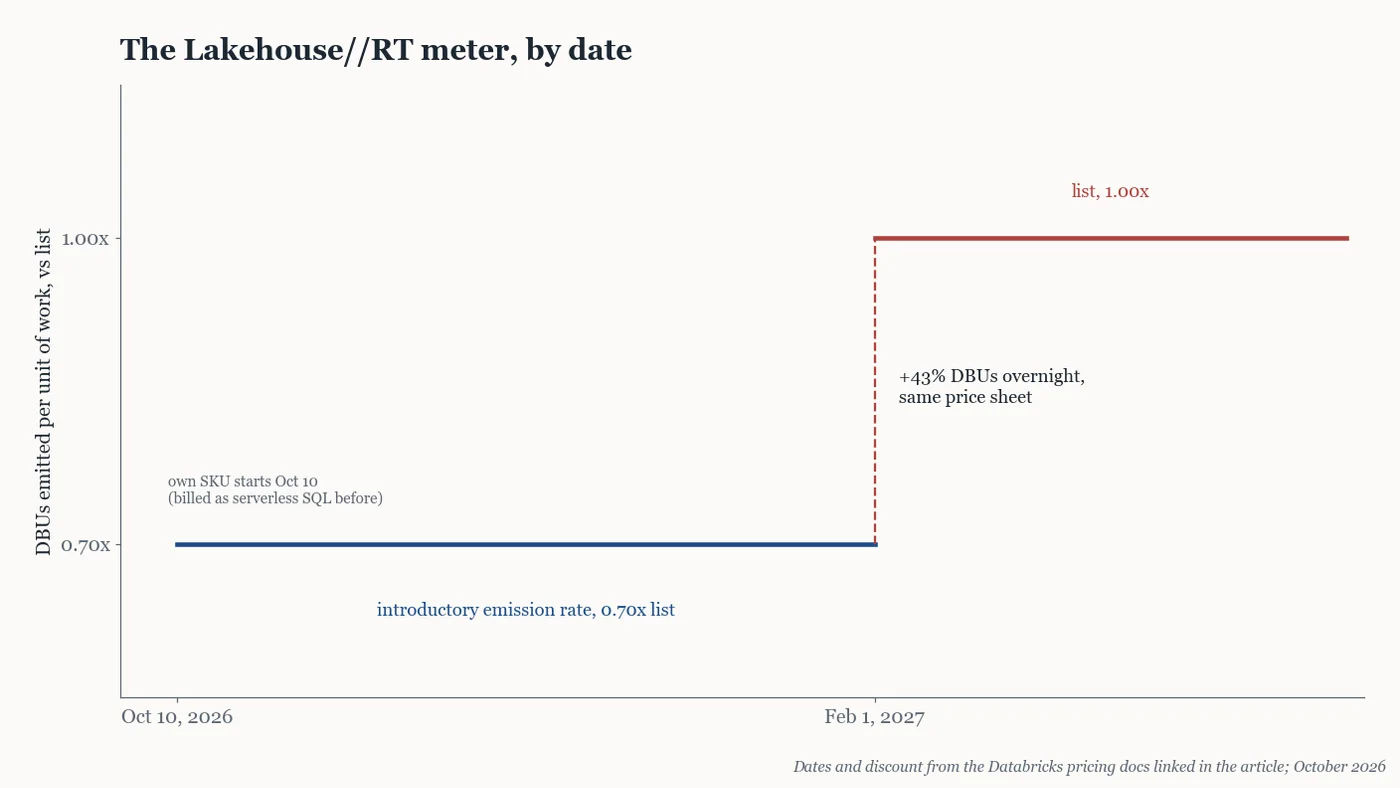
The product is still in Beta, and the documentation says plainly that performance characteristics and the supported feature set "will change before general availability." The meter is further along than the product. Per the pricing page, the beta billed at serverless SQL rates until October 10; since October 10 it bills on a SKU of its own, Lakehouse Serverless Compute, at regional list. A 30 percent introductory discount runs through January 31, 2027, implemented not as a lower price but as a lower emission rate: the list price never moves, the warehouse simply emits 30 percent fewer DBUs until the promotion ends. On February 1 the same workload emits 43 percent more DBUs than it did the day before, and nothing on the price sheet will have changed. We have reviewed this genre of meter before.
What the SKU buys
Narrower than the pitch. Lakehouse//RT runs ANSI-mode SELECT queries only: no writes, no DDL, no Python UDFs, no system tables, no external tables, no federation. Connections go through the Statement Execution API or a driver configured to use it, and a legacy Thrift driver gets a 501 for its trouble. The governance the one-platform pitch leans on is not all there either; row-level security and column masking sit in the limitations list. A serving layer is read-heavy by definition, so SELECT-only is fair. Shipping the meter before the row filter is a choice worth noticing.
Verdict
Wait, with homework assigned. If you pay for a dedicated serving layer today, the discount window is a sensible time to benchmark Lakehouse//RT on your own queries at your own concurrency, because the 16x will not be yours. Price the result at the February emission rate, not the one in the console this quarter. A beta that bills on its own SKU, with an introductory discount and an expiry date, is generally available in every sense that touches a budget. Treat the GA label as the formality it has become.