 The Vertex Journal
Economics
The warehouse pricing models, reviewed as designs
Per-credit, per-slot, per-TB and serverless per-second are not four prices for one thing. They are four incentive systems, and each one trains your team differently.
By The editors · · 2 min
The journal has reviewed cost levers within a platform. Today's subject sits one level up: the pricing models themselves, reviewed the way we review designs, because that is what a pricing model is. Each one encodes a theory of how you should behave, enforced by invoice, and choosing among them is an architecture decision wearing procurement's clothes.
The specimens, by family. Credit models (Snowflake's): you buy abstract units consumed by compute time, sized by warehouse tier. Capacity models (BigQuery's slot commitments): you reserve throughput and queue against it. Scan models (BigQuery on-demand and its per-TB kin): you pay for bytes read, storage priced separately. And serverless per-second across the newer entrants: pay for exactly the compute seconds used, no idle, no reservation.
What each one trains. Credit models train warehouse hygiene: the billable unit is time-on, so the discipline that pays is suspending idle compute and right-sizing tiers, and the failure mode is the 4XL someone provisioned for a backfill in 2024, still humming. Scan models train query authorship: the billable unit is bytes touched, so partitioning and column discipline become visible virtues, and the failure mode is the analyst's SELECT * against three years, priced like a small car. Capacity models train queue management: the spend is fixed, so the discipline moves to scheduling and the failure mode is invisible, paid-for slots sitting empty at 3 a.m. Serverless trains nothing, which is its pitch and its trap: no idle to manage, and no friction against the ten-thousand-small-queries pattern that sums, quietly, to more than the reservation you declined.
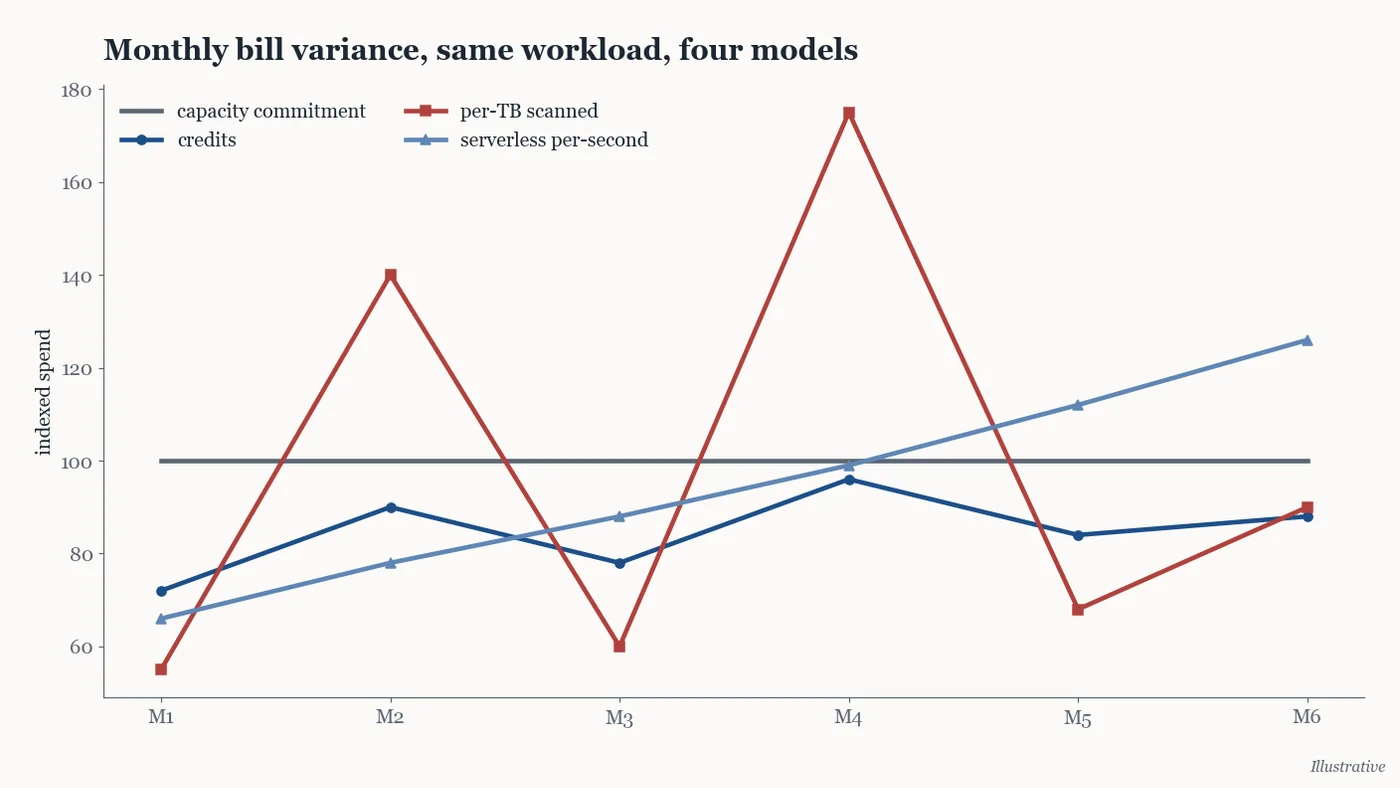
The chart shows the property buyers actually experience: variance. Same illustrative workload, four models: capacity is flat and occasionally wasteful; scan is spiky and punishes curiosity; credits sit between, tracking discipline; serverless tracks usage perfectly, including the usage you did not know you had. Predictability and efficiency trade against each other across the whole set, and no model gives you both without operational attention. The vendors know this, which is why each one's marketing leads with the failure mode of its competitor's model.
The verdicts, by buyer rather than by vendor. Finance-led organizations that price predictability above efficiency: capacity commitments, sized honestly against history, with the empty-slot report as the standing audit. Engineering-led teams with real cost discipline: credit or serverless models reward the discipline directly and invoice its lapses. Ad hoc analytical estates full of explorers: scan pricing is the dangerous one; either train the explorers or put a capacity ceiling under them, because the model converts curiosity into spend at list price.
And the standing rule, which survives every model: whatever the unit, meter it weekly at the team level, because every one of these designs relies on the gap between consumption and attention. The invoice is a lagging indicator of behavior nobody watched. The pricing model decides which behavior. That is why it is a design review, and this one, unusually for the genre, is a review you re-run at every renewal for free.