 The Vertex Journal
Platforms
Managed Iceberg, the S3 Tables verdict so far
AWS made the table format a bucket feature. What the managed layer actually buys, what it costs against running your own, and who should wait.
By The editors · · 2 min
When AWS shipped S3 Tables, the pitch was disarmingly small: buckets that understand Iceberg, with compaction, snapshot cleanup and catalog wiring handled by the storage layer. The format war ended in the open column; the product war moved to who operates the format for you. This is the journal's check on the managed option, now that it has enough runway to judge.
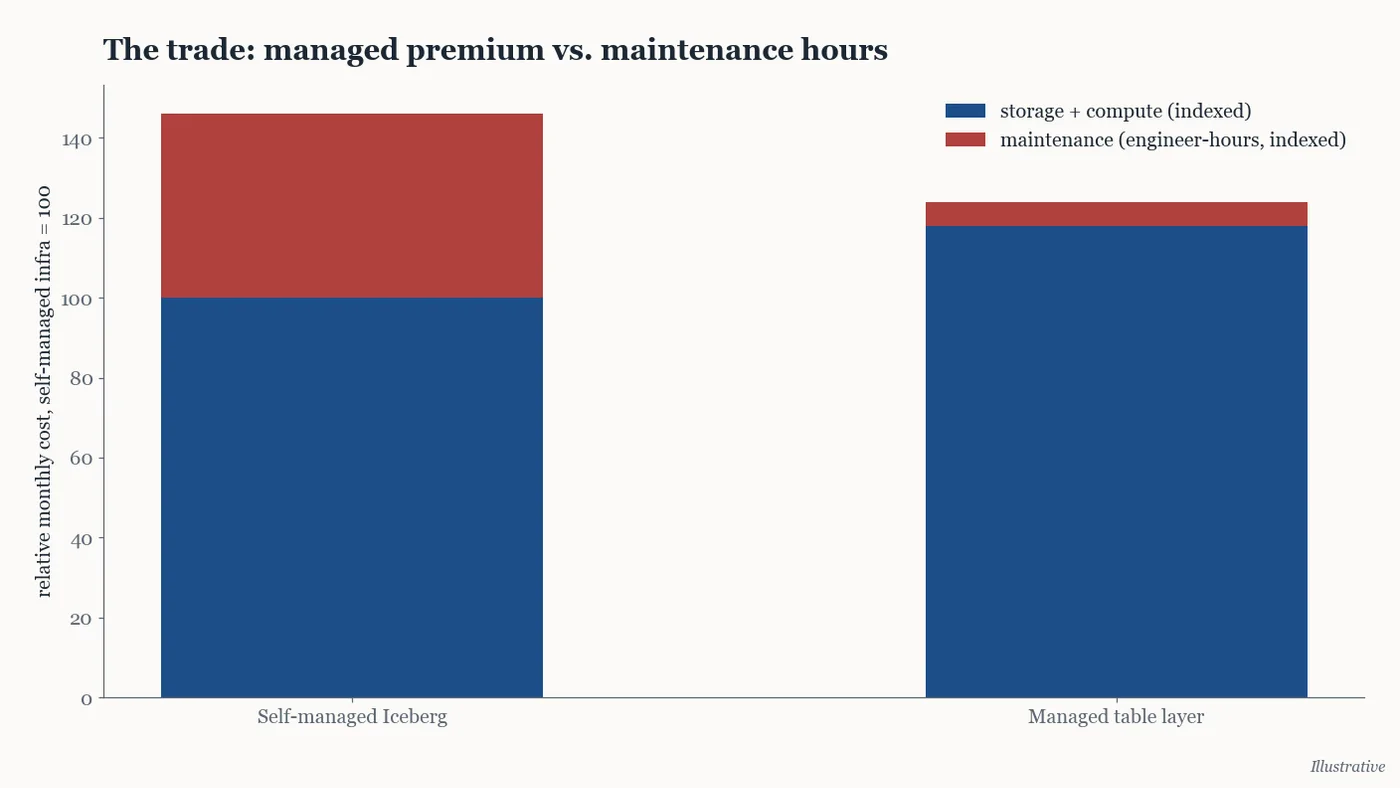
What the managed layer genuinely buys: the maintenance nobody budgets. Self-managed Iceberg's dirty secret was never the format; it was the housekeeping, the compaction jobs, the orphan-file sweeps, the snapshot expiry that every team implements badly once and then owns forever. Moving that into the storage service is real value, priced per gigabyte and per request, and the chart shows the shape of the trade: the managed premium against the operations hours it deletes. For small-to-mid estates the premium wins comfortably. Illustrative, as ever; your compaction bill knows your truth.
What it costs beyond the meter: the usual gravitational pull. Tables that live as a bucket feature integrate most smoothly with the same vendor's catalog, query engines and permissions, and each convenience is a small vote against the portability that made Iceberg attractive. Nothing here locks the data (the format remains open, which is the point), but the operational surround, the catalogs and grants and pipelines, re-accumulates around one vendor unless you spend discipline against the current.
The verdicts, split by reader. Running Iceberg today with an engineer's week per quarter going to table maintenance: adopt, and reassign the week. Choosing a first lakehouse layout: adopt with the exit story documented on day one, meaning catalog definitions and permission models kept in portable form, per the interchange argument. Multi-cloud estates or heavy non-AWS engine users: wait; the value of managed housekeeping is real but the integration gravity works against your actual architecture, and your compaction jobs, however ugly, are at least neutral.
The genre note this product confirms: the open-format era's vendors compete on operations rather than formats, which is better for buyers than what preceded it, and still a competition. The format being open was the armistice. The housekeeping is the new front, and it is priced by the gigabyte.