 The Vertex Journal
Economics
Warehouse cost levers, ranked by yield
Most warehouse bills respond to four interventions. The ranking, the yields we have seen, and the lever everyone pulls first that matters least.
By The editors · · 2 min
Warehouse pricing models differ; warehouse bills do not. Across the platform field, spend concentrates in the same places, and the effective interventions rank in roughly the same order. Illustrative ranking, based on the pattern rather than a single dataset; your bill will vary in degree, rarely in shape.
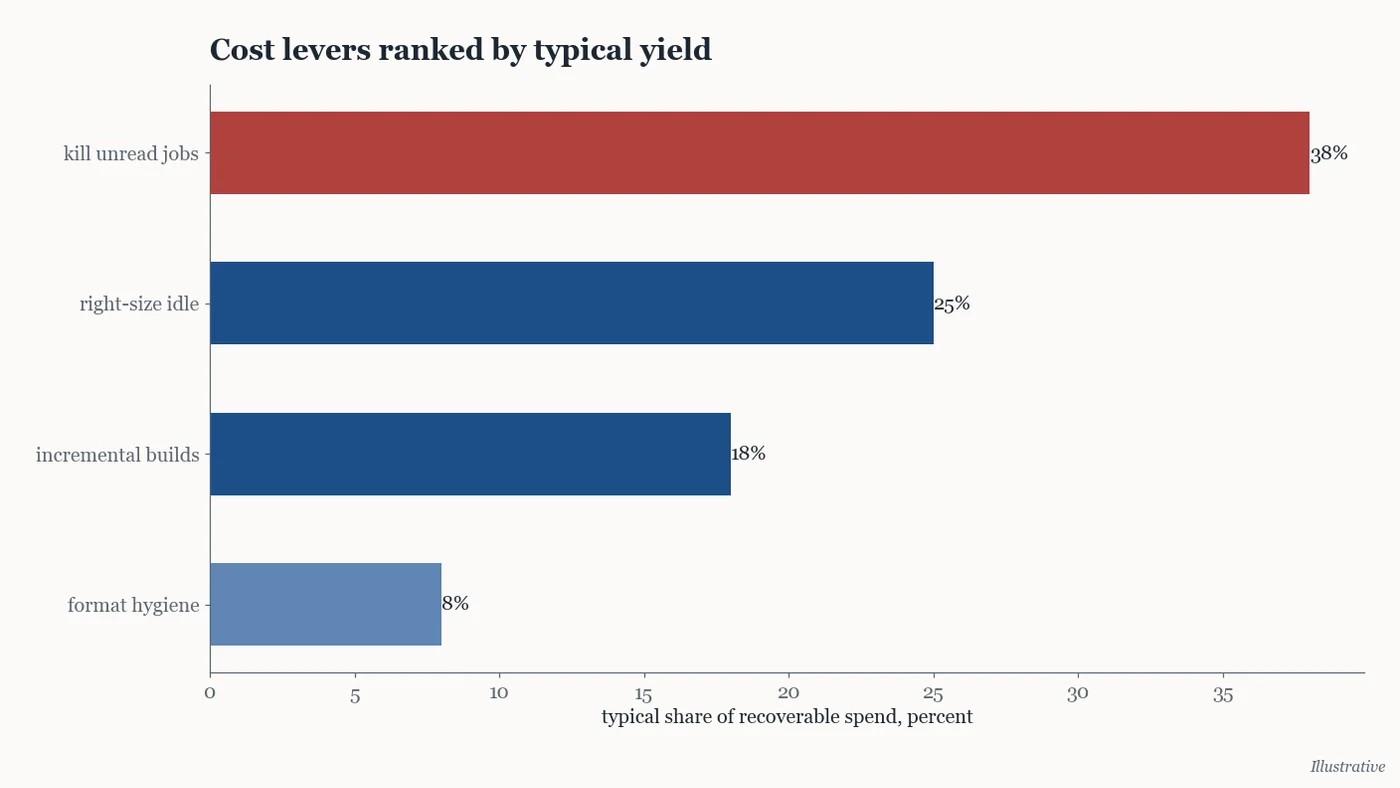
Lever one: stop computing things nobody reads. The scheduled rebuild of a dashboard viewed twice a month, the staging tables for a project that shipped and died, the hourly refresh into a weekly meeting. This is the highest-yield lever on almost every bill and the least glamorous, which is why it goes unpulled.
Lever two: right-size the always-on. Oversized compute with lazy auto-suspend settings burns money at 3 a.m. for nobody. Idle burn is pure waste, and it hides because each instance looks small.
Lever three: incremental over full rebuild. The transformation layer recomputing unchanged history nightly is a subscription to work already done (the tooling that fixes this structurally is half the current market's pitch).
Lever four: storage and format hygiene. Compression, partitioning, pruning. Real, worth doing, and almost always smaller than the three levers above it, despite generating the most conference talks.
why the ranking holds across pricing models
The levers survive vendor differences because they attack behavior, not rates. Whatever the meter charges per second or per credit, work nobody consumes is a pure loss at any price, idle compute is a rate multiplied by zero value, and recomputing unchanged history pays full price for information you already own. Negotiating the rate, the intervention finance reaches for first, changes the coefficient on all of it and the shape of none of it, which is why estates that cut a better deal without pulling the levers watch the bill regrow to its old silhouette within a year. Pull the levers first and the renewal negotiation improves anyway, because nothing strengthens a procurement position like a usage graph that has stopped climbing.
verdict
Pull the levers in order. The industry's persistent preference for lever four is a mystery best explained by the fact that levers one and two require telling a colleague their dashboard is dead, and file formats never argue back.